
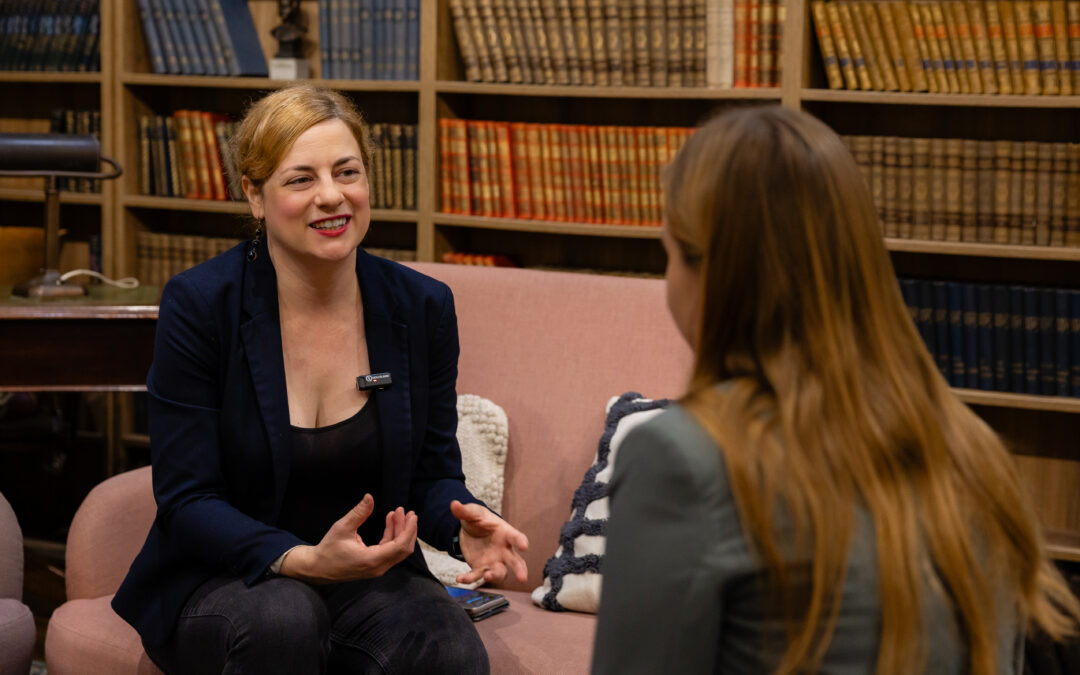
In the rush of deadlines and client demands, it is easy for lawyers to slip into a constant “firefighting” mode—leaving little room for deliberate work, strategic thinking, or even recovery. But is this way of operating inevitable? Or is it shaped by ingrained patterns and expectations that can be rewritten through more conscious time and energy management? These are the questions we explored with Dr. Eszter Bodnár, lawyer, habilitated associate professor, coach, and trainer, who helps legal professionals build more sustainable and focused ways of working. Interview by Viktória Nagy (Ars Boni)
Many say burnout is almost inherent to the legal profession. What invisible patterns keep so many on the edge?
Constant workload and overtime are deeply embedded in the image of being a lawyer. From law school onward, we are often socialized to believe that working day and night is normal. This leads to a continuous state of overload which, without periods of decompression, is very difficult to sustain in the long run.
Another key factor is the reactive nature of legal work. Lawyers are constantly responding—to deadlines, clients, situations. When someone operates permanently in this “firefighting” mode, little time remains for proactive tasks, even though these are often the greatest sources of energy and professional growth.
Let’s be honest: it’s not just external expectations—internal standards also create pressure. Why is it so hard to let go of the belief that “I’m only a good professional if I’m always available”?
Because legal work is driven by deadlines and client needs, it is easy to fall into a mode where everything seems to require an immediate response. This is reinforced by the fact that, from the client’s perspective, almost every matter appears urgent.
If someone structures their work entirely around this reactive mode, important but non-urgent activities tend to be pushed aside—such as strategic thinking, consciously building one’s practice, continuous learning, or even rest, which is essential for sustaining long-term performance.
For example, I worked with a lawyer who felt that clients could call at any time—even at night or on weekends—despite not working in criminal law. In our work together, we explored the cost of this approach: what important but non-urgent tasks it was taking time and energy away from.
When did it become clear to you that time management and conscious work habits are just as critical as legal expertise?
I have always been interested in time management. I come from a very active family, where daily life was dynamic, and this sparked my early curiosity about how to function effectively in such a pace.
At university, I observed highly intelligent law students underperforming simply because of poor time management. Later, as a professor, I often saw students arrive at exams exhausted, unable to deliver the performance they were capable of.
Today, I see the continuation of this pattern among clients: most lawyers feel they never truly reach the end of their work. There is a constant sense of restlessness, as if something is always unfinished, creating ongoing tension in everyday life.
You are not only a lawyer, but also a coach and trainer. How did coaching become part of your career, and how did time management become central to your work?
The transition to coaching happened quite naturally. Even before I engaged with it professionally, I was already helping people around me develop their potential.
I started with career coaching, then moved into business coaching, and in both areas, the question of effectiveness quickly emerges. In career planning, for example, it is important to consider how much someone wants to work in the long term, at what pace, and how they want to divide their time between deep work and administrative tasks.
In business coaching—especially with lawyers—time management becomes a core part of professional advice.
You teach at Eötvös Loránd University, as well as in Heidelberg and Canada, you publish in multiple languages, work as a coach, and are also involved in classical music projects. How do all these roles come together?
My life is quite adventurous. From the outside, my path may seem somewhat zigzag, but for me these roles connect very naturally. What unites them is that in each one I help people bring out their full potential.
Often, I work with individuals who have an idea, a plan, or a talent that is still taking shape, and I support them in this process from behind the scenes.
Teaching is exciting for the same reason—especially the mentoring aspect, when students are working on a thesis or dissertation and the goal is to help them achieve their best.
As a coach, I mostly work with lawyers, but also with musicians, entrepreneurs, and executives. With them, I often support the entrepreneurial side of building a career or project.
How do you manage all this in daily life? Are there specific methods you rely on?
I am interested in many things and usually have more ideas than I can realistically implement. That is why it is important to be patient with oneself and accept that not everything can be done at once.
One useful practice for me is deliberately creating periods when the “idea pipeline is closed.” During these times, I do not start new projects but focus on advancing and completing existing ones.
Another key habit is a weekly check-in, where I review what happened in the previous week and what lies ahead: tasks, progress, and areas needing more attention. It serves as a stable anchor, especially when multiple projects run in parallel.
There is no shortage of methods and tips, yet few achieve lasting change. What mindset shift is truly needed?
Many people treat time management as a technical issue—what system or method to use. But the more important question is why we want more time.
Some want to do even more work. Others want to finish earlier and have more time for family, friends, or passions. If this “why” is clear, it becomes much easier to build a system that actually works.
Most people expect to receive a ready-made structure to follow. Many books and courses promise this. But we are all different—our nature, rhythms, and goals vary. I see productivity methods as a palette from which each person must create their own system. This is an experimental process that requires curiosity: trying something, evaluating whether it works, and understanding why if it doesn’t.
Who would you recommend your “Effective Time Management for Lawyers” course to—and why invest time in it when time is already scarce?
I primarily recommend it to lawyers and law students who feel constantly overloaded and want to work more consciously. The course encourages participants to reflect on their own patterns: how they use their time, what gives them energy, and what drains it, while offering tools to find methods that suit them best.
Many say they do not have time for this. But in reality, it is precisely when we are most overloaded that it becomes most important to invest time in time management. Even a small reflective space can trigger significant change.
If an overwhelmed lawyer or law student wants to start managing their time more consciously tomorrow, what is the first step?
One of the simplest yet most powerful steps is to start observing one’s own patterns. For example, over the course of a week, tracking how time is spent: what activities take time, what gives energy, and what drains it.
This is crucial, because we are not just managing time—we are managing energy and attention. While we all have the same amount of time, our energy levels and ability to focus vary significantly. Effective performance is often more about this than about scheduling alone.
Even this simple awareness can lead to powerful insights. Change rarely begins with a big decision—it starts with small, conscious steps.
The interview was originally published in Hungarian on Ars Boni, on 22 April 2026.
hello@ebodnar.com
Follow
By-weekly postcards
Inspiring stories, life and work design tips, book recommendations and so on – right in your inbox.